Showing posts with label plywood boats. Show all posts

Wednesday, December 30, 2015

Amateur Boatbuilding Coming Alive Again

All things boating have taken a hammering over the past decade, with most people suffering to a greater or lesser extent through the financial woes that flooded the world. Initially, amateur boatbuilding seemed to stay quite strong, while sales of production boats went into a deep slump.

After amateur boatbuilding also started to weaken, it was interesting (but distressing) to observe the progression of the slowing sales around the world. First to go were the industrialised countries, led by USA and UK, then it spread to less developed countries. It is said that when America sneezes the world will catch the cold. When we lived in South Africa we could watch that phenomenon and knew that what was happening financially in USA, whether up or down, was likely to be mimicked in South Africa within a year or two.

The one market that seemed to stay remarkably buoyant was Russia, where amateur boatbuilding seemed to stay strong. Then war and politics stepped in, the Russian economy took a dive and sales of plans to amateurs in Russia also fell.

Boats are not an essential part of life for most people. For some they are transport or a work implement, for others they are a home but for most people their boats are toys, sporting equipment, or somewhere between, certainly not high on the list of essentials when money becomes tight.

Now we seem to be coming out of that slump. The US economy has been showing signs of life for a year or two and that now seems to be filtering down far enough that amateur boatbuilders are again starting new projects. If the normal pattern pertains, the upswing will spread out to the rest of the world as well.

Over the 35 years that I have been designing boats professionally, I have drawn mostly boats that are suitable for amateurs to build. This was not an intentional path in my design career but, in retrospect, was probably the most natural and logical one. My roots are in amateur boatbuilding, when I built a plywood 36ft cruiser/racer in my in-laws' garden, based on a design by Ricus van de Stadt. My own first full design was the CW975 for a 32ft plywood racer/cruiser, which I also built after it won a design competition. The third design that I drew was the steel Pratique 35 cruiser for an amateur-builder friend. Next was the Coquette 39 plywood racer/cruiser commission, also for an amateur. Only after that did I receive my first commission from a professional builder for a production GRP boat.
My own 2nd big boat project, the CW975 "Concept Won", in my garden.
This depth of involvement with amateur boatbuilders and designs has resulted in a long string of commissions for amateur builders, mostly for plywood. My own third build big-boat project, in the form of the radius chine plywood Didi 38 "Black Cat", and my well-publicized voyaging in her, have reinforced that trend. For the past 30 years I have always had at least a year of work waiting in  line. That has now expanded to a 2-year backlog and I have had to turn away new commissions to keep the backlog somewhat manageable.

As the slump deepened, the average size of boats that people chose to build slipped lower, until we were selling only dinghies and trailer-sailers. Now that average size is starting to creep upward again, as builders move back into bigger boats. The most durable design that we have is the Argie 15, which has developed a good following that keeps it going strongly through thick and thin.
Argie 15 built by Andrey Borodikhin in Moscow, Russia.

In trailer-sailers, the little gaffers, in the form of the Cape Cutter 19 and Cape Henry 21, are the ones that keep going. These lapstrake plywood boats are more complicated projects than a simple stitch-&-glue boat but they are just so pretty that they have attracted a good following. They have also proven to be quick in the light stuff and capable in the rough stuff, so they have grown a reputation for being desirable boats. That resulted in the upward expansion of this design range with the Cape May 25.
Beautifully-built Cape Cutter 19, built by Sergio Vianna of Curitiba, Brazil.
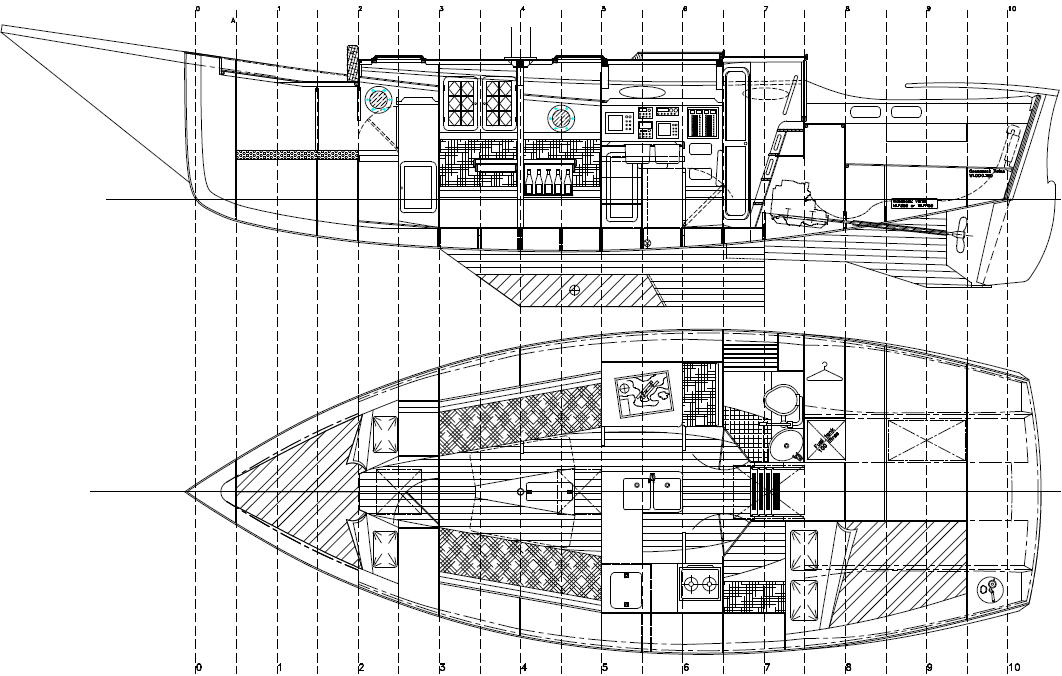
Newest in this series, and already generating much interest even before completion of the design, is the Cape Charles 32. Although not yet on our website and pricelist, drawings have already gone out to the first two builders. This one is a coastal and offshore cruiser, with shallow fixed keel and external ballast, whereas the smaller sisters have steel centreplates and internal ballast. We should have a web page for this design in a month or two. Until then, please email me for info on plan price etc.
Accommodation layout of Cape Charles 32 cruiser.
It is not only cruisers that are growing in popularity. One of the commissions that is waiting for attention is a bigger sister to the radius chine plywood Didi 950, at 11.4m (37ft). I have also been asked multiple times to draw a Didi concept to the Class 40 Rule but am not able to fit in the design in a reasonable time, so have turned down the commissions. Meanwhile other larger boats in our radius chine plywood range are also starting in various countries. This includes the first in that series, the Didi 38, with two new builds starting in Asia.
Didi 950 radius chine plywood racer/cruiser.
We are also experiencing increased interest in steel cruising designs, which have been very dormant for the past 10 years. Overall, amateur boatbuilding is looking a lot more healthy now than it has for a long time. Now we all need the politicians in all of our countries to play nicely together. If they do that then life should improve for all of us. Lets all go play with our boats.

To see more of these and our many other designs, visit http://dixdesign.com/ or http://dixdesign.com/mobile.

Sunday, February 22, 2015

To Paint, or Not to Paint

Last week the builder of one of my boats asked me about painting the interior of his boat, what should he paint and what shouldn't he paint? I had not really thought of it before, that there are different thoughts about what to paint and why. Before I answer, I will tell you of my experiences on a wide range of boats, those built by me and those built by others.

On all of the big boats that I have built (they were all for my own use), people who visited the boats or sailed with us often commented about how fresh they were down below compared with their own boats or others on which they had sailed. I had observed this as well. There was never any diesel smell, never any dank, damp odour and never any need for air fresheners on my own boats. In contrast, many of the other boats were oppressive as soon as I went below, with some rather bad smells.

Most of these boats had been owner-built or owner-completed and they all had large areas of plywood that were unpainted, left as raw timber, under berths, in the bilges etc. My own boats had no exposed timber, not inside lockers, under cabin soles, inside the lazarette, under berths, not anywhere.

So, how does this make such a difference? A boat lives in a wet environment and most are closed up the majority of the time. When the sun is shining, the inside of a boat is much warmer than outside and that warm air soaks up moisture from any water that is in the bilge or elsewhere. Humidity builds up and creates an ideal atmosphere for mould to grow. Mould spores are in the air all around us and waiting to proliferate.

When the air cools in the evening the moisture is wrung out of the air again. It settles as condensation on hull, deck and joinery surfaces throughout the boat. It doesn't care whether they are exposed surfaces that you see whenever you are on the boat or hidden ones that you seldom see. The humidity is everywhere in the boat when it is hot, so condensation settles everywhere when it cools.

The unpainted wood surfaces absorb some of this moisture and hold onto it. It becomes that ideal environment for the mould spores to settle and grow. Once it starts, if left unchecked, the mould will spread throughout the boat and can also be the start of rot problems.

Mould inside the boat can be difficult to kill off. It needs to be killed everywhere and the surfaces must be thoroughly dried then sealed with epoxy or paint so that the cycle doesn't start again. It would have been so much easier to have just painted everywhere when the boat was being built. Sure, painting everything will have added a few weeks to the build time but it will have been worth the extra effort to save the hassles of the future.

The same principle applies to preventing diesel smells. Every big boat has a diesel or oil spill or two in its life.That liquid will soak into any raw timber that it contacts. Once into the surface it is impossible to remove and it will result in diesel or oil smells inside the boat for the rest of its life. If those surfaces had been painted then the problem would never have arisen.

So, what coatings should you use? All surfaces of the hull and deck skins, as well as all associated timber framing (stringers, backbone, beams, sheer clamps etc) must be protected by three coats of epoxy. This should include the perimeter of bulkheads against hull and deck but you may prefer to coat all bulkhead surfaces as well. The epoxy needs to be protected from the attack of UV (even below decks) so I recommend painting over the epoxy with a prime coat, followed by undercoat and finishing coat of paint.

Elsewhere, coat with primer, undercoat and finish coat. That means every timber surface, whether you will see it again or not. If it is a sealed compartment, e.g. inside a swim platform, don't leave it unpainted either. These sealed compartments must be coated inside with three coats of epoxy but you don't need to paint them.

Aside from mould, smell and rot prevention, there are other reasons to paint everywhere. 
  • Painted surfaces are very easy to clean. You can throw a bucket of water in the bilge or a locker, swill it around and then pump it out, no harm done. Or you can wipe it down with a damp cloth or sponge rinsed in a bucket, very easy.
  • Light-coloured paint reflects light, unlike raw timber that absorbs it. The painted compartments are bright and make it easier to find things that have gone astray. A fully painted lazarette is not a dungeon that swallows up tools and other things that will not be seen again until you build up the courage to dive into that dark place in search of lost treasures. That also applies to cabins in the ends of the boat, which are much more bright and habitable if painted in light colours. Clear-finished okoume plywood becomes quite dark, has uninteresting grain patterns and is not as attractive as you might imagine, not by a long way.
This problem is not limited to owner-built plywood boats either. I have seen this regularly when poking around inside boats displayed on boat shows in London, Annapolis and other places. Many production builders don't bother to protect the timber surfaces inside lockers, lazarettes, berths or the bilge. It costs them labour and materials to do so and it costs the owner down the line to sort it out or live with the results.

So, don't bother to argue with yourself over which surfaces to paint and which to leave raw, just get down to it and paint them all. You can thank yourself later when you reap the benefits.

Allied to this is the need for good ventilation. Strategically positioned ventilators will help to keep the air fresh inside your boat, removing excess moisture and making it a much more pleasant environment for people instead of mould.

Dudley Dix
Dudley Dix Yacht Design
http://dixdesign.com/